Weeding is a library term for removal of items from a collection. It is the final step in the cycle of library materials. Like a gardener, the librarian goes through the collection systematically removing dead growth, looking at everything and pulling out items that detract from the collection. As in the case of a beautiful garden, your vertical file will thrive with regular weeding.Sitter, Clara L. The Vertical file and its alternative: a handbook. Englewood, Colorado: Libraries Unlimited, 1992, pp. 64-71.
Purpose of weeding Weed to insure the quality of your vertical file as a resource. It is critical that your collection, which should seek to have the most current materials in certain subjects, be kept up-to-date in order to provide your patrons with resources they can depend on being accurate and current.
Weed to make your collection more appealing. As in a garden, if you do not pull the weeds, your patrons cannot see the beauty. Your files will look better and people will be able to find what they seek more easily.
Weed to conserve space. Even if you do not need the space now, you will someday. It is much better to stay on top of it than to wait until you run out of space and have such a huge job it will never get done.
Weed to save time in searching and maintaining the collection. Patron time and staff time will be saved by keeping files up-to-date. They will not need to reject outdated materials found in the files.
Weed to keep a close check on the collection. Regular weeding will keep you more familiar with the collection. You will be able to encourage use and see that the management of the files is carried out in the most efficent manner.
Weed to provide feedback on the strengths and weaknesses of the collection. Going through the collection in a systematic way will keep you aware so that you are subconsciously tuned in to this valuable resource. You (or the person responsible for the files) will be the most critical link in the development and use of the collection.
Negative factors to consider when weeding
There are several guides to help you in weeding library materials. (Stanley J. Slote’s Weeding Library Collections, 3d ed. (Englewood, Colorado : Libraries Unlimited, 1989)) is a standard reference for weeding book collections. Slote’s factors for weeding materials include attention to appearances, duplication, content, age, and use. Joseph P. Segal (Evaluating and Weeding Collections in Small and Medium-sized Public Libraries: The CREW Method, Chicago: American Library Association, 1980) developed a system of weeding called CREW, which stands for Continous Review, Evaluation, and Weeding. The system is based on the date of the material, time since it circulated, and whether or not the material is “MUSTY”:
M – misleading or factually inaccurate
U – ugly
S – superseded by newer information
T - trivial
Y – your collection has no use for the material or material is irrevelant to your patrons
The formula may not be applicable to your files, but the MUSTY factors are important to consider in weeding any collection. Using the negative factors as a guide gives you a basis for evaluating materials.) Many of the general factors for consideration also apply to vertical-file materials. Weeding is discussed in different terms, but the negative factors for consideration can be grouped in the following general categories.
Content. Is it accurate? Poor content or incorrect and misleading information is the most important factor in weeding.You must discard inaccurate information. Bad information is worse than no information at all.
Age. Age is a very important factor in vertical-file materials. Currency is one of the characteristics of supplementary materials. Ask yourself the following questions: Is the information more than five years old? Has the material been updated? Do you have a current address for the publisher? Age is easy enough to evaluate if it is printed on the item. The next best indication is the date that the item was added to the collection. You should be able to assume that the information was current when it was put into the file. Stamping the date received is important even when the date of publication is available so that you know that as of the date received it was considererd current.
Need. Is this the only source of this kind of information? Need based on extra copies is an easy factor. The difficulty is when you have the information available in a different source. Ask yourself the same questions you did before you added the material: Is this information somewhere else in the library? Or Is this information in another library in the area?
In the case of superseded information, there is probably no good reason to keep an old version of supplementary material when you get a new one. If you have questions about keeping older information, refer to the questions you asked yourself regarding the initial selection.
Is this information still needed? A number of items in your supplementary materials collection may seem trivial. The characteristics of supplementary materials include unique, unusual, and small segment of knowledge. There may be a fine line distinguishing unique from trivial in evaluating supplementary materials. You will have to answer that question for your own library.
Use. Is this material used? Is it used often? Circulation systems that leave a record of use make this an easy factor to evaluate. For example, the date due stamped on the back of item, a check-out card for the item, or a bar code attached to the individual record would track the use. Another way to measure use is to put a small hash mark on the back of the item each time the file is filed. It is not a foolproof system but it may give some indication of use. You will have to determine whether it is important for you to know.
Condition. Appearance is an easy factor to evaluate. When items become yellow, torn, dirty, or ragged, it is time to discard or replace them. If the material is valuable and you cannot replace the item, then you should consider marking a photocopy. If you use some protective material or preservation techniques when you add items, you can avoid some of the appearance problems for materials that will receive heavy use.
To summarize, you need to consider the following in your evaluation of materials for weeding: Content, Age, Need, Use, Condition = CAN U C (Can you see any reason to keep these materials?).
When to weed
Most librarians agree that weeding should be done once a year. It can be done as a large project all at once; you can do it continually; you can do spot weeding; or you can do a combination. Except for some special collections such as archives or local history, supplementary materials need to be weeded to give life to the collection.
Annual weeding. Many special collections are most efficiently weeded once each year. Dated items such as annual reports, newsletters, or college catalogs can be discarded at the end of the year, keeping only the current year, latest two years, or more, depending on your policy. If you know you will discard on a certain date, try using a bright coloured dot with the discard date written on it to speed the wedding process.
To do an annual weeding as one large project, you might consider some of the following recommendations: (1) put weeding into your annual schedule to insure adequate time; (2) choose a slack time in the library, for example, near a holiday; (3) set up a system for weeding; and (4) put your files in order before weeding.
Continous weeding. Continous weeding incolves setting up a system so that you are weeding some on a regular basis throughout the year. There are several ways to do continous weeding. One way would be to schedule one subject area per month for systematic weeding. Another might be to schedule a certain amount of time each week for weeding. You could do one file each day. You can establish your own schedule for a continuous weeding plan.
Spot weeding. Spot weeding means that you check some of the folders some of the time. Unless you combine it with another systematic weeding process, some folders will never be weeded. There are several suggestions for spot weeding. First, check each folder as new material is added. Do a quick check of materials in the folder to see whether (1) the new material updates an earlier edition, (2) older materials contain historical or background information that is omitted in recent works, (3) the new item adds a different dimension or restates what is already there (if it does not offer a fresh approach, determine whether it is needed anyway because of the popularity of the topic). Then detemine whether there is a need for two copies. Pencil the date checked on the file when it has been examined. Second, check each folder as it circulates. Examine each folder and discard material that is (1) no longer useful, (2) inaccurate, (3) worn or in poor physical condition, or (4) superseded with newer versions. Change subject headings that need to be updated; divide the file into finer groupings if it is too full; discard material from overcrowded folders, boxes, and drawers; and regroup materials into broader headings if needed. Pencil the date checked symbol on the file when it has been weeded.
Weeding, like the other steps in the life cycle of resources, offers a number of options. The important thing is to do it and to continue the process by locating new resources, adding them to your files, maintaining them, and thus keeping the cycle alive.
Summary recommendations
- Establish a policy and procedure for weeding certain kinds of materials.
- Keep your files “lean and clean”.
- Set up a plan for systematic weeding and schedule it into your work day, week, month, or year.
Monday, November 28, 2011
Weeding

Monday, November 21, 2011
Government publications
Why collect?
Government information is generally produced by the party currently in power.
How do we find information? The government is not always forthcoming
Weekly checklist (pink sheet) key Federal selection tool
Federal depository program
Verification problems
Another issue, depends on how much material library is receiving
- Canadian market may be too small for a trade publisher to produce more specialized material, may have to turn to government sources fo the Canadian angle
o Statistics Canada produces Canadian statistics
o Canadian government has three levels: federal, provincial and municipal
o Compared to the likes of US/UK markets, Canadian market is small - Parliamentary committees, task forces, Royal Commissions produce in depth reports
Government information is generally produced by the party currently in power.
- Propaganda
o Election campaign material, not necessary good or bad - Policy/issue studies
- Annual reports
o Accountability - Statistics
- Legal (debates, bills, statues)
o Hansard, otherwise known commonwealth
o Bills are introduced, discussed and study. They must pass a reading and be proclaimed to come into effect.
o Statues are documents classification - Science & technology, marketing, business studies
o Agriculture, economics - Popular treatments
How do we find information? The government is not always forthcoming
- Scan newspapers
- Use checklists
- Go directly to department, agency
- Mine government websites e.g.
Weekly checklist (pink sheet) key Federal selection tool
- Searchable catalogue from Jan. 1991 – available on Internet http://publications.gc.ca/site/eng/weeklyChecklist/weeklyChecklist.html Checklist does not list all government publications, may have to track down source and try to obtain from department which produced it (fugitive/grey literature)
- Major preelectronic was pink
- Lists book/magazines/productions released by government and Statistics Canada
- Key provincal selection tool
- Compiled by Legislative Library, provides six most recent publications
- http://www.gov.mb.ca/chc/leg-lib/checklist.html
- Each department is meant to notify the Library as to what they are publishing. Back issues are not available online.
Federal depository program
- Full depository libraries
- Selective depository libraries
- 8 Manitoba libraries automatically receive current Manitoba government publications
Verification problems
- Small publication runs
o Limited - Lack of centralized listing
o Checklists don’t list everything - Ephermal natural of some publications
o Here today, gone tomorrow publications - Consulting reports done for government agencies, crown corporations
- Reorganization and name changes for government departments
- Colloquial names for royal commissions and inquiries, etc.
- Crown copyright
o Government retains copyright - Cost recovery and user fees
o Smaller more expensive - Electronic formats
o Some publications are only available on the Internet, they won’t always be there - Preservation and archiving
o Depository was meant to keep everything all the time – what do you do with publications that aren’t kept online all the time?
Another issue, depends on how much material library is receiving
- LC/Dewey
- Catalogue numbers
o Canada: catalogue numbers
o U.S. Superintent of Documents (SuDocs) - CODOC
- Jurisdiction: country or organization, then by department or division, and finally by title
- Separate vs. integrated collections
Monday, November 14, 2011
Previewing
The actual process of selecting audiovisual materials is often a group rather than an individual activity. This is particularly true of films and expensive video sets. To some degree, the cost of the material under consideration, rather than the usual collection development factors, drives the issue. In essence, making a mistake about a 20-minute sound, colour, 16mm film or educational video has more serious economic consequences for the library budget than most single mistakes with a book, transparency or sound recording. Educational videos cost $200 to $500 per cassette, in a multiple-cassette package, the total cost is substantial. Having multiple opinions about a prospective purchase helps avoid costly mistakes. In public libraries and school media centers, an audiovisual selection committee is the typical mechanism employed for securing multiple points of view. In academic libraries, often a single faculty member makes the recommendation, assuming that the purchase will be made with departmental funds, or the head of the library’s media program selects titles on the basis of reviews and a knowledge of instructional needs.Evans, G. Edward, with the assistance of Zarnowsky, Margaret R. Developing Library and Information Center Collections, 4th ed. Englewood, Colorado: Libraries Unlimited, 2000, pp. 304-306.
How does the audiovisual selection committee differ from the book selection committee? Audiovisual selection committees usually function as a true group decision-making body. Normally, the group previews audiovisual materials under consideration, as a group. They view the material from beginning to end. (With book selection, the typical approach is for committee members to divide the items among group members and have individuals give oral reports about each item. Thus, only one member of the committee reviews the item completely.) A group discussion usually takes place after each screening, and each person expresses a reaction to and evaluation of the item. Everyone sees the same material, and group interaction ends in a decision to buy or not to buy. Sometimes the product is rerun several times, when there are strong differences in opinion.
An important difference in the two formats affects the selection process. This is the sequential nature of films and video formats. It is not possible to effectively skim a film as one does a book. One must view films and videos at their normal speed to get the proper impression. A 20-minute running time means 20 minutes of previewing time. Simple arithmetic indicates that a group previewing 20-minute films could view only 24 films in a 8-hour work day. A book selection committee meeting would be a disaster if only 24 titles were discussed in 8 hours. Realistically, no group can preview 24 titles in 8 hours, as the figure does not provide for discussion time or breaks. Finally, it is not feasible to expert people to view materials for four hours straight; they need a break. All of this means, more realistically, that the group could preview 10 to 12 items per day.
Not only do audiovisual formats cost more to buy, they also cost more to select. Combined, these two cost factors can be significant. Thus, one cannot conclude that, because a library does not have a collection of films or videos, it is reluctant to accept new formats. A significant difference exists between reluctance and a lack of money and qualified staff to select the newer formats. The only question is whether the library is using the monetary factor as an excuse to avoid trying out nonprint formats.
Additional selection aids
Despite the desirability of previewing audiovisual materials, published evaluations (especially when combined with previewing) are important in this field. Each year, there is a little more progress toward bibliographic control of the field, including reviews of most formats. Perhaps when multiple published reviews of a majority of formats are available, therer will be less and less need for hundreds of audiovisual librarians to spend hours and hours in preview screening rooms.
At this time, no comprehensive source for audiovisual materials similar to Book Review Digest or Book Review Index exists. Media Digest (National Film and Video Center) has developed into the best source for locating reviews in all formats.
Identifying potentially useful audiovisual materials also presents a problem. The National Information Center for Educational Media (NICEM) focuses on educational material; however, because NICEM employs a rather broad definition of education, the publications are useful to all types of libraries. NICEM Net (http://www.nicem.com) allows one to search the entire database by subject, age level, and media type. The 1999 subscription was $900 for a single-user license for a year. (One can also get online access to the database through DIALOG, SilverPlatter, and EBSCOHost. CD-ROM, tape load, and print versions are available.) The database contains almost 500,000 records in English and 60 other languages. Its primary strengths lie in the video, film, audio recording, filmstrip, and CD-ROM formats, although there are records for almost every format discussed in this chapter. NICEM also has a 300-page thesaurus of terms used to index the database, which is a great help inn formulating accurate searches. This database is as close as one can come to an audiovisual equivalent of Books in Print.
Although the preceding list of sources provides a general overview, there is a slight emphasis on films. One reason for this is historical. After microforms and phonograph records, motion picture films and videos are the most commonly held audiovisual forms in libraries. Also, 16 mm films and educational videos cost significantly more than either of the other two formats, making previewing all the more important. Because of film’s popularity, cost, and longer history of use, film review and evaluation have had more time to become established. Increased popularity of other formats will, in time, make it economically feasible to publish journals covering other audiovisual formats.
Some of the most active nonprint discussion lists are: videolib@library.berkeley.edu, VIDEONEWS@library.berkeley.edu, and MEDIA-L@BINGVMB.CC.BINGHAMTON.EDU. These provide information on how to handle various media issues as well as information about sources.
Ordering media
For all practical purposes, the process of ordering materials in the formats discussed in this chapter is the same as for ordering books and serials, with a few exceptions. One difference is that libraries place most of the orders directly with the producer, because there are no general jobbers as there are for books and serials. Some book jobbers, such as Baker & Taylor, handle some of the most widely collected formats (for example, videos and audiotapes), but they do not handle the full range of audiovisual materials. Another difference is the need to secure preview copies.
There is a major difference between review copies of books and preview copies of other media. With books, if the purchasing librarian likes what he or she sees, the library keeps it, pays the invoice, and perhaps orders multiple copies at the same time. With audiovisual materials, for a number of reasons (risk of loss, damage, and so forth), the library usually requests a preview copy from the supplier, views the copy, and then returns the item. (Some producers now send a new copy – especially for videos – and expect the library to keep the copy if it decides to buy the item. Other producers charge for previewing, but deduct the charge from the purchase price. A few film vendors ship an approval copy with a 10 percent discount if the library buys the film.) One must request the preview copy well in advance of the preview date. Normally, a librarian writes to the producer or supplier asking for preview copies of certain titles and listing a number of alternative dates. This becomes an issue when previewing with a group, because of scheduling problems. One also must know when specific items will be available for previewing. A preview file thus becomes a very important aid in the selection process; it contains a listing of each title requested, the dates requested, scheduled preview dates, and the result of the preview.
One should keep in mind several othehr factors for previewing as well. A preview copy may have had some prior use; therefore, the quality may not be as high as that of a new copy. If one can determine from the supplier how often the item went out for previewing, it is possible to gain insight into the durability of the product. In assessing this information (assuming one can get it), thetl ibrarian must remember that the preview copy’s use was by individuals who know how to properly handle the material (unlike many library users).
Upon receiving the purchased copy, a staff member should view the item to be certain it is (1) a new print, (2) the item the library ordered, and (3) technically sound (checking for breaks, sound quality, and quality of processing). Checking for technical soundness upon receipt should be standard procedure for all audiovisual items, not just for previewed items. Generally, other media are not mass-produced in the same manner as are books. Many are produced on demand, that is, in response to orders. The producer has several preview copies and a master copy; when an order arrives, the producer uses the master copy to produce a new print.
One issue to decide before ordering is that of performance rights. Does the library pay an additional fee for public performance rights, or are they part of the quoted price? (This is a typical issue for videos.) There may be some justification for paying a somewhat higher price for performance rights in an educational setting, but therer is hardly any when the videos are for circulating home use. The classic example of the confusion between “the home market” and “the library market” was Public Broadcasting System’s release of its series The Civil War in 1990. Initially it was available to libraries for $450; only a few months later, PBS released it to the “home market” for just under $200. Another example, from 1995, was Malcolm X: Make it Plain: $99.95 from PBS Video (with public performance rights) and $29.95 from MPI Home Video (with home video rights). Failure to have public performance rights and using a film or video in a “public performance” setting could lead to a very costly lawsuit. Knowing how the item is most likely be used, acquiring the appropriate rights, and maintaining a record of what was purchased can be important in building media collections.
With some formats, there may still be another decision: to buy or rent. Normally, the rental fee is 10 percent of the list price. If there are doubts about the level of demand, it may be best to rent a copy. (Ten uses in five years would be more than enough to justify buying the item.) Remember, when calculating the cost, that it will be necessary to include staff time for preparing rental forms, as well as time for mailing and handling activities. In many cases, with film, video, and software, the library is not buying an item in the same sense that it purchases books and serials. Often the library must sign an agreement that outlines what the library may or may not do with the item. These agreements cover duplication and resale and, in some cases, place restrictions on where performances are possible. Vendors do enforce these agreements, which are legal contracts, so the librarian must understand what he or she is signing. If something is not clear, or if a clause should be modified, the librarian should discuss it with the vendor and the library’s legal counsel before signing.
Summary
Building a media collection for the library is a time-consuming and expensive undertaking, but it is important and worthwhile for both the library and its service population. Each new format is capable of doing certain things that no other format can do, but each also has its limitations; as a result, they supplement rather than replace each other. It is clear that patrons have various preferences in seeking, using, and enjoying information. If the library is to responsive to the community, it must build a collection of materials that reflects that community’s various interests and tastes.
Monday, November 7, 2011
General evaluation criteria
To a degree, the same factors that determine inclusion or exclusion of books apply to other formats. Obviously, one omits factually incorrect items unless there is a sound reason to buy them. Poorly organized and badly presented material seldom becomes part of the collection. If the quality of a book is difficult to assess, assessing the quality of other media is even more difficult. All of us have seen a film we enjoyed only to hear a friend claim that is is “absolutely the worst film” ever made. Thus, subjectivity is a major concern. Though bias is also a problem with literature, we receive more training or exposure to good literature through formal schooling. Few of us receive formal training in evaluating nonprint materials. Basically, the issues of authority, accuracy, effectiveness of presentation or style, and value and usefulness to the community are as valid for all other formats as they are for books.Evans, G. Edward, with the assistance of Zarnosky, Margaret R. Developing Library and Information Collections, 4th ed. Englewood, Colorado: Libraries Unlimited, 2000.
Before embarking on a program to develop a media collection, one should carefully evaluate each format in terms of its unique utility to the service community. Each format has its strong and weak points, and similar information may be available in a variety of formats. The following paragraphs offer general guidelines for assessing the strengths and weaknesses of various forms.
Formats that involve motion (such as 8mm, 16mm, and 35mm films, videotapes, and video discs) are among the more expensive formats to purchase. Therefore, an important question to ask is whether motion really adds information. There are films in which there is no motion at all, or, if there is motion, it may not be relevant to the content. For example, many educational films and videotapes simply alternate shots of one or two persons talking to one another or to the viewers (so-called “talking heads”); there are no other graphics (or, at least, no graphics that require this expensive mode of presentation). In contrast, one can read hundreds of pages and look at dozens of still photographs of cell brision and still not fully understand how it occurs. A short, clearly photographed film combined with a good audio track can sometimes produce a more accurate understanding than one can achieve through hours of reading.
Detailed study is sometimes most effectively carried out with the use of still pictures, charts, or graphs. Another advantage is that the cost of producing and acquiring these formats is much lower than for those that involve motion.
With both motion and still graphic formats, color is an important consideration. Full-color reproduction is more costly than black-and-white reproduction; the question is whether the color is necessary or merely pleasing. In some instances, color is necessary. Certainly, anything that attempts to represent the work of a great artist must have excellent color quality, as is also the case with medical and biological materials.
Audio formats can also provide greater understanding and appreciation of printed materials. One’s own reading of a poem is never the same as hearing the poet’s recitation of the work. Tone, emphasis, inflection, and so forth can change the meaning of a printed text dramatically. On a different level, there are literally millions of people in the world who cannot read music scores and yet get enormous enjoyment from listening to music. Audio recordings are a must in any collection serving the visually impaired. Spoken-word recordings can be an important service for such persons as well as for commuters who want to listen to a book as they travel.
Other general selection factors include cost, flexibility and manipulation, and patron preference. Audiovisual factors frequently require expensive equipment in addition to rather costly equipment. When thinking about cost factors, one needs to know what types of equipment patrons own (for example, slide projectors, videotape players, CD or tape players, or even record players). If patrons do not own the necessary equipment, can the library supply it free of charge or on a rental basis? Should the library buy the equipment and allow its use only in the library? The librarian also must consider what patrons like and use. Libraries ought not to get into the position of attempting to change patron format preference. Thus, both cost and patron preference become significant in deciding what to buy or not to buy.
Flexibility and manipulation are inseparable. How and where can one use the format and equipment? With some equipment, the library can produce local programs as well as play back commercial software. Videocassette recorders (VCRs) allow people to perform a variety of recording and playback functions, most of which (like freeze frame) no one uses. Knowing community needs and use patterns may save the library money. Special VCR features may be necessary, nice, or merely gimmicks, depending on the local situation. Ease of operation is very important: Can a person quickly learn to operate the equipment, or does it take extensive training to use it properly?
Once one’s library decides to develop a media collection, how does one select appropriate items? There are four sets of factors to consider – programming, content, technical aspects, and format – with criteria related to each factor. The following paragraphs highlight major selection criteria.
Programming factors
Programming (that is, use of material) is important in deciding what to acquire. Many articles and books about this topic are available (see the bibliography at the end of this chapter). Programming questions include:
- Will the medium be used in formal instructional situations?
- Is it only for recreational use?
- Who is the primary audience: adults, children, or all ages?
- Will the item circulate, or will it be available only for in-house use? If used in-house, will it be available to individuals or only to groups? Will group use involve a library staff member or an expert in the field to guide group discussion before or after the item’s use?
- Will the library be a member of a resource-sharing network? If so, will the item become part of the shared material pool?
Answers to these questions will affect the type of media purchased and the prices paid. For example, many videos for home use are less expensive than videos for instructional use, even when both packages are the same title.
Content factors
Content is the next concern in the selection of any format. In the past, audiovisual selection was a group process rather than the sole responsibility of one selector. This was especially true in the case of expensive formats. Today, with the prices of videos dropping and increasing numbers of titles needed for the collection, the selection process is more like book selection, that is, an individual process. School media centers still emphasize the group process, in part because of limited funds but also because the possibility of someone objecting to an item’s presence in the collection is higher than in other types of libraries. Whether selection is a group or individual process, housing an evaluation form is useful. Keeping the forms for several years, for titles rejected as well as those purchased, can save selectors’ time in the long run. Unlike print material, most media are sequential in nature; this means that it takes 50 minutes to review a 50-minute program. An evaluation form indicating that the library reviewed and rejected an item three years ago should help selectors decide whether the item is worth reconsidering. No matter what questions are on the form – and not all items listed in this chapter will be on any one form – one ought to consider all of the following points:Technical factors
- What is the primary purpose of the item? If there is a user’s guide, does it provide a specific answer to the question?
- Given the purpose(s) of the item, is the length of the program appropriate? Items can be too short, but more often than not, they are too long.
- Is the topic a fad, or is it likely to have long-term interest? Long-term interest and lasting value are not always the same.
- Is the material well organized?
- Is the storyline easy to follow?
- If the item is of relatively short duration and is an attempt to popularize a subject, does it do this with sufficient accuracy? (That is, does the simplification cause misunderstandings or, worse, create a misrepresentation?)
- When was the material copyrighted? Copyright information can be difficult to find for some formats. Films usually provide this information somewhere in the credits, often in roman numerals. There is no national bibliographic standard for this information. Sales catalogs may or may not provide the date of production. Unfortunately, a large number of dated products are, or have been, sold as if they were current.
- Will the visuals or audio date quickly? In many educational films, the subject matter is important but the actors’ dress makes the film appear old-fashioned. If one does not present the material as historical, many viewers may miss its true purpose. Audience attention is easily drawn away from the real subject. Needless to say, this ties into the need for accurate copyright information.
- Are there multiple uses for the item, in addition to those identified by the producer? If there are a number of ways to use the format (with various types of programs or audiences), it is easier to justify spending money on the item.
Technical issues vary in importance from format to format, but some general considerations apply to several formats. In most instances, judging technical matters is less subjective than judging many other selection criteria. Nevertheless, it will take time and guidance from experienced selectors to develop a critical sense of these factors. Most individuals entering the field of library and information work are more attuned to good literature, well-manufactured books, and the various methods of literary review and criticism than the average person. Though our exposure to television, film, and video recordings may be greater than to books, few of us have the background to assess the technical aspect of these formats. The fact is evident during film and television awards ceremonies – the public interest is in the best film or program and performance categories. It is the rare individual who can name the winners in the technical areas (directions, production, special effects, cinematography, and so forth). Following are some questions regarding technical features:Format factors
- Are the visuals, assuming that there are visuals, necessary?
- Are the visuals in proper focus, the composite effective, the shots appropriate? (These questions must be asked because out-of-focus shots, strange angles, and jarring composition may be used to create various moods and feelings).
- Is the material edited with skill?
- Does the background audio material contribute to the overall factor?
- Is there good synchronization of visuals and audio?
- How may the format be used – can it be viewed by small or large groups or by both? Can it be viewed in a darkened, semi-lighted, or fully lighted room?
Questions to ask about format are:
- Is the format the best one for the stated purpose of the producer?
- Is the format the least expensive of those that are appropriate for the content?
- Will the carrier medium (the base material that supports the image or sound layer) stand up to the amount and type of use that library patrons would give it?
- If damage occurs, can it be repaired (locally or by the producer), or must one buy a replacement copy?
- What equipment is needed to use the medium? How portable is the equipment and how heavy?
Additional considerations
It is possible to group all audiovisual materials into six broad categories: still images (filmstrips, slides, microformats, transparencies); moving images (film and video); audio recordings; graphic materials (maps, charts, posters, etc.); three-dimensional materials (models, relia, dioramas); and other formats (games, software, etc.). Each type has some equipment or storage implications that one needs to take into consideration. For example, microform storage cabinets are heavy when empty and become even heavier when filled. Until one knows that the floor was designed to carry such weight, which is greater than book stacks, one should be cautious about starting a major collecting program in that format.
Monday, October 31, 2011
Electronic resources
Definition of electronic resource
An electronic resource is a manifestation of a work encoded for manipulation by computer. The manifestion resides in a carrier accessed either directly or remotely. Some electronic resources may require of a peripheral device attached to a computer (for example, a CD-ROM player). This definition does not include electronic resources that do not require the use of a computer, for example, music compact discs and videodiscs.
Cataloguing Electronic Resources: OCLC-MARC Coding Guidelines. 6 Dec. 2001. 25 Mar. 2002.
An updated definition is available on the OCLC Website at http://www.oclc.org/support/documentation/worldcat/cataloging/electronicresources/
Type of electronic materials
- Full-text
- Music
- Numeric databaseso Statistics
- Reference materialso Bibliographieso Indexeso Abstractso Tables of contentso Almanacso Encyclopedias
- SoftwareIssues
- Licensingo # of users allowed at one timeo Remote accesso ILL or sharing allowed?
- Selection criteria applicable to electronic formato Ease of useo Searching capabilityo Operating system platformo System hardware requirementso Ease of downloading* Emailingo Printing capabilities* Downloadingo Access* Full MARC cataloguing, links on library Web site, etc.o Selection when same “title” available in various formats and versionso Access vs ownership* Who is able to use the database?* Must subscribe to gain access.o Preservation (will it always be there?* There may not be paper copies of all electronic resources.o Duplication/overlap between print and electronic resources* Do you want both?* Weigh pros and conso Technical concerns* Staff/patron training* Technical support* Ease of installation* Compatibility with existing hardware/software
- May not be able to upgrade easily* Availiability/reliability of telecommunications, servers, etc. for materials accessed remotely* Viruses
Auer, Nicole J. “Bibliography on Evaluating Internet Resources.” 20 Aug. 2001. 26 Mar. 2002. http://web.archive.org/web/20020127084051/http://www.lib.vt.edu/research/libinst/evalbiblio.html Contains link to interactive module on evaluating Internet resources.
Selection tools
American Library Association, Association of College & Research Libraries. C&RL NewsNet: Internet Reviews Archive. 14 Feb. 2002. 26 Mar. 2002. http://www.bowdoin.edu/~samato/IRA/
Contains reviews of Internet resources written by librarians.
AcqWeb. Online Information Vendors and Electronic Publishers. 26 Mar. 2002. http://acqweb.org/pubr/online.html
Choice. Reviews Web publications.
Scout Report. 15 Mar. 2004. http://scout.wisc.edu/Reports/ScoutReport/Current/
Published every Friday both on the web and by email. It provides a way to stay informed of valuable resources on the Internet. Professional librarians and subject matter experts select, research, and annotate each resource. From University of Wisconsin.
Nonprint selection criteria
Programming
- Formal instructiono How will it be used?
- Recreational use o Buy, not show in group, show at home nit pick, rent a movie show at home to friend
- Audience (adults, children, all ages)
- Circulate/in house
- Member resource sharing network
This is especially true for the more traditional nonprint, audio and visual. When going to acquire a book (shop, jobber, online) , get a discount for a wide variety of selection. There is a much easier paper trail. Must preview videos for their suitability before presenting. Chapters sell CDs and videos, a few educational, more commercially; few bookstores sell many AV materials. Go to distributor – they are just selling the product, not making it. Ask for a preview before committing to buy, check the suitability. Non-print materials aren’t as widely reviewed as print materials. Also rent videos if they won’t widely be used for a period of time.
Content
- Primary purpose?o Entertainmento Educational
- Length appropriate?
- Topic of long term interest?o Will it be here today, gone tomorrow?
- Material well organized?
- Story line easy to follow?
- Popularization accurate?
- Copyright date?o Tends to be longer than on books.
- Will visuals or audio date quickly?o Visuals impact audience. It needs to look current to appeal.
- Multiple uses?
Technical
- Visuals necessary?
- Visuals in proper focus, composition effective, shots appropriate?
- Skillfully edited?
- Does background audio contribute to overall impact?
- Good synchronization of visuals and audio?
- How may format be used?
o Small/large groups, both?
o Darkened/semi lightened/fully lighted room?
- Best format for producer’s stated purpose?
o How to needs to be repetitive - Least expensive format of those appropriate for content?
- Will format stand up to amount and type of anticipated use?
- If damaged, is repair possible or purchase of replacement required?
- Maintenance required?
- What are equipment requirements?
Sources of reference
Evan, G. Edward, and Margaret R. Zarnosky. Developing Library and Information Center Collections. 4th ed. Englewood, Colo.: Libraries Unlimited, 2000. (Z 687 E918 1999)
Gregory, Vicki L. Selecting and Managing Electronic Resources. New York: Neal-Schuman, 2000. (Z 692 G74 2000).
Monday, October 10, 2011
Guidelines for acquiring vertical material
Need or place in the collection
- Will the material be used?
o If not, do you have a good reason to acquire it? - Will the material be used often?
o If not, can you justify getting it? - Is this the only source of this kind of information in your library?
o If not, will it add to the collection? - Does your collection need this viewpoint?
o If not, does it add information?
Presentation
- Is this format desirable?
o If not, do you really want? - Is this material easy to use?
o If not, do you have a good reason to add it?
Authority
- Is the material accurate?
o If not, should you even consider it? - Is the material from a reliable source?
o If not, do you have a good reason to add it? - Is the material objective?
o If not, can you justify putting it into the colection? - Is the name and address of the source on the item?
o If not, have you written it on the item?
Timeliness
- Was the item published within the past three years?
o If not, is it valuable for historic reasons? - Is the date printed on the material?
o If not, have you written the date of reciept on the material?
Adapted from: Sitter, Clara L. The Vertical File and Its Alternatives: A Handbook. Englewood, Colo. : Libraries Unlimited, 1992.
Sample Form Letter
Middle School Library1234 Middle StreetMiddletown, ManitobaR3G 1X4
Dear Sponsor:Please send one copy of the following free materials for use in our library. If there is a charge, please advise us before sending the materials.
We appreciate your help in assisting us to build a collection of supplementary materials to enrich our library.Sincerely,I. M. PlainVertical File Co-ordinator
Monday, October 3, 2011
Organization
The usefulness of supplementary materials is dependent to a large part on the way they are organized. Supplementary resources vary so much in format, subject, size, and use that it is impossible to wrap them up in one neat organization package. There are three important elements in the topic of organization: the type of organization, subject headings, and indexes. These areas represent some of the most important decisions you will make regarding your supplementary materials collection.
Types of organization
Here we discuss several options for generic approaches to the organization of supplementary materials for your vertical files. The easiest ways to organize information are based on the basic concepts of arranging materials either alphabetically, numerically in sequence, or a combination of the two in an alpha-numeric system.
An example of a simple alphabetical arrangement of material would be to arrange by some obvious element of the work such as name or title. This is the arrangement used for most indexes and directories. Organization by numerical sequence can be a simple 1, 2, 3 arrangement or 00001, 00002, 00003. A variation of numerical arrangement is chronological, such as 1991, 1992, 1993; or 92-0001, 92-0002.
When organization is by subject, materials can be arranged alphabetically by subject or classified by subject using one of the standard classification systems. Most libraries use either the Dewey Decimal Classification system or the Library of Congress (LC) Classification system. Dewey has a numerical system for subject classification, and LC uses a combination of letters and numbers in its alphanumeric system.
Special collections of materials often have unique characteristics that provide logical ways to organize them. It is likely that you will have one or more special collections. Particular problems related to specific types of materials will be addressed later. The important thing to remember in the decision for the arrangement of materials is to select the system of organization that works best for your collection. Use the system that you think will be best for your users but keep it as simple as possible.
Alphabetical by subject – the dictionary arrangement
The widely used system of organization that employs an alphabetical arrangement of subject headings is sometimes called a dictionary arrangement. This arrangement is an efficient, economical way to cope with supplementary materials and is probably the most popular approach. This approach has a number of advantages. First, it is direct. There is no need to translate verbal ideas into an artificial code. Second, it is simple. The alphabetical arrangement is easy to understand and to manipulate. Patrons can be more independent in their use of the files. Third, it is detailed. A dictionary approach allows for the use of individualized and definitive terms, which speeds access to materials. Fourth, it is adjustable. New subjects are easily added to a dictionary arrangement. Refinements of old subjects are easy to incorporate. Fifth, it is easy to spot weaknesses because materials on the same subject (but not related subjects) are filed together. An empty file indicates a lack of materials. However, the dictionary arrangement has several disadvantages: related materials are not filed in proximity to each other, for example, lions and tigers; additional cross-references are necessary to ensure that materials are found; and outdated material is harder to weed than in a sequential system because you must look at each item in every file.
Classified by subject – Dewey or Library of Congress (LC) arrangement
The concept of classifying pamphlet material appears in the early literature of the profession, written when the few pamphlets permitted inside a library were given legitimacy by being classified and placed on the shelves with their more respectable cousins. Sometimes single pamphlets were allowed in this distinction, but more often related pamphlets were bound together into what were called pamphlet volumes or into groups of associated pamphlets in boxes on the shelves with the books.
If you decide on classification for your supplementary materials, you will most likely use the same classification system used for your book collection. In theory, using Dewey or Library of Congress classification numbers for all library resources simplifies and correlates their use. (Full cataloguing of supplementary material is a luxury not possible (or desirable) except for exceptional materials. The advantages of full cataloguing are tighter control over the material, fuller indexing, and greater likelihood of permanency. Disadvantages of full cataloguing include increased cost in time for processing, delays in availability of materials because of increased processing time, and reduced likelihood of materials being weeded when they are outdated. Permanency can be either an advantage or disadvantage and in many cases will be the most important factor in your decision regarding full cataloging.)
The classification of pamphlets and other supplementary materials without full cataloguing is done in some collections. Some librarians shelve pamphlet boxes with related books in the traditional manner; others set aside small rooms or areas where boxes of pamphlets stand in general classification order. Classified pamphlets and clippings are frequently housed in vertical filing cabinets.
A few attempts have been made at constructing special classifications schemes for general vertical files. If the decision is made to classify materials, then the advantages and disadvantages should be considered carefully. Special collections are often organized by a specialized system for the particular discipline or material. Advantages in using Dewey or LC systems include:
Ease of use of a ready-made scheme like Dewey or LC. Unless there is a special scheme that can be easily used for special types of materials such as the Superintendent of Documents (SuDocs) number or the Dictionary of Occupational Titles (DOT) system, then you have a good reason to invent your own system.
Logic of applying the same finding code to all library resources on the same subject. This concept of unifying all library resources is particularly appealing to school librarians who are eager to present a quick overview of all library holdings on a particular subject to teachers and students.
Helpfulness of having related subjects in close physical proximity. For example, the patron who is interested in pets may find it useful to have all pamphlets on dogs, cats, and hamsters within easy eye range rather than scattered through the file under widely separated headings. Physical closeness, made possible by the classified system, makes it more convenient to work one’s way back to broader classes if information is not found under the specific topic.
Ease in surveying the library’s holdings in the basic areas of knowledge in a classified system. Strengths and weaknesses in relation to the collection as a whole are readily apparent.
Some of the problems related to using a classified system include the following:
Generalized classification blurs the emphasis on specifics. The classification of supplementary materials does not work as well in practice as in theory because of an important characteristic of supplementary materials: Most of them concentrate on small areas of emphasis with very specific subjects. The result is use of a long, complex classification number or the burial of the item in a general class number that will not give a precise clue to its contents.
Generalized shelving also blurs the emphasis on specifics. Shelving pamphlets with related books presents the same problem of weakening the specific approach, though the addition of full cataloguing helps somewhat.
Using Dewey or LC may not be expedient. One of the arguments for collecting supplementary materials is the availability of very current materials. When librarians are forced to make decisions regarding classification in addition to assigning subject headings, the processing of materials is likely to be slowed to the point of losing the edge of currency.
There is a lack of flexibility. New concepts are slow to appear in revisions and updates of classification tables.
Classification involves dependence on an index to the collection. The artificial symbol creates an additional barrier between the user and the information.
Sequential by number – accession number arrangement Some libraries do not attempt to physically group their materials by subject; rather they simply arrange them by order of receipt. Materials are marked with a sequential code consisting usually of an accession number, e.g., 91-0001, 91-0002, 91-0003, but sometimes a combination of letters and numbers, e.g. P-0001, P-0002, P-0003, for pictures is used. Access is achieved through an index. The index can be a card file, a part of the card catalog, or a computer file. The code number is recorded under the appropriate subject or subjects. If author and title cards are used, the code number is recorded there also.
A sequence of bar codes can be assigned to the vertical files or to special collections of materials. If items are organized by bar-code number, it serves as an aid to both organization and circulation. Other options for the use of bar codes will be discussed in chapter 10, “Circulation”.
Dale E. Shaffer incorporated a modified form of serial arrangement in his Sha-Frame system. His plan called for arranging pamphlets by size as well as by acquisition or der. This system is no longer for sale, but there may be remnants of the system in some libraries, and the booklet is available on interlibrary loan.
The flaw of using a sequence or accession system is in retrieval. Retrieving only one pamphlet is no problem, but this system discourages the use of multiple pamphlets on the same subject. Browsing is not possible and the system depends upon materials being kept in precise order.
The use of a computer simplifies the record-keeping part of a sequential system. Difficulty in retrieval is still a concern; however, filing by accession number does facilitate the weeding process based on date. The system has been used successfully in personal information files for librarians and teachers.
Subject heading alternatives You have several alternatives in your choice of an authority list for subject headings. You can use a subject-headings list written for vertical files; you can use the standard subject-headings list used for the book collection; you can select headings from various indexes and other guides; or you can make up your own authority list by consulting a combination of available resources and using the headings most appropriate for your users.
Subject-headings lists written for vertical files There have been some lists of subject headings written specifically for vertical files, but they are soon out-of-date because of the nature of the materials that belong in information files. Subject-headings lists used in the past include the following out-of-print resources:
Ball, Miriam Ogden. Subject Headings for the Information File. 8th ed. New York: H. W. Wilson, 1956. This list was based on headings used in the Newark (New Jersey) Public Library.
Ireland, Norma Olin. The Pamphlet File in School, College, and Public Libraries. Rev. ed. Boston: F. W. Faxon Co., 1954.
Subject Headings for Vertical Files. 2d ed. Toronto, Canada: Toronto Public Libraries, 1971. Based on Sears List of Subject Headings. Canadian emphasis.
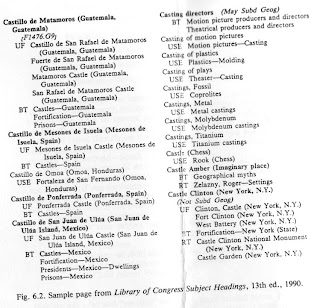
Standard subject headings for the book collection The use of standard subject-headings lists for the book collection, i.e. Sears Lists of Subject Headings (see figure 6.1) and Library of Congress Subject Headings (see figure 6.2), can be used for many topics. Adopting one of these standard lists has both advantages and disadvantages. (HCL Authority File is a subject-headings list designed by the Hennepin County Library System (Minnetonka, Minnesota: Hennepin County Library. Quarterly microfiche for $7.50/year). The authority file is updated regularly by the HCL Cataloguing Bulletin (Hennepin County Library. Bimonthly for $12/year). It is user oriented and provides an alternative authority list for subject headings.

 Get a second copy. If an item fits two subject areas, get a second copy or photocopy portions to put under the second heading if copyright infringement is not an issue. (If you duplicate material under two headings, note on each item the location of the other copy.) Another option for dealing with dual subjects is to put a referral note in the related file.
 Catalog entry. You can have entries in your library catalog ounder the main subject with cross-references to related subjects (“see also”) and terms that are not used as subject headings (“see”). It is sufficient to use a generic note like the following: “For information on this subject consult the Vertical File.” Sample “See” and “see also” cross-reference cards or entries may read “For additional information on this subject consult the Vertical File: [give the subject or name of the file].” Sample reference cards may be found in figure 6.3. Give enough information to be helpful to the patron but keep it simple enough to be easy for you to manage. In some case you may want to adapt the scope notes included in the LC and Sears subject-heading guides to provide additional information for your patron.
  Computer index printout. A computer index is easy to update, and you can provide frequent updates near the files and at the reference desk. Copies can be duplicated for individuals or departments. Your index will be more helpful with numerous cross-references (see figure 6.4).
Types of organization
Here we discuss several options for generic approaches to the organization of supplementary materials for your vertical files. The easiest ways to organize information are based on the basic concepts of arranging materials either alphabetically, numerically in sequence, or a combination of the two in an alpha-numeric system.
An example of a simple alphabetical arrangement of material would be to arrange by some obvious element of the work such as name or title. This is the arrangement used for most indexes and directories. Organization by numerical sequence can be a simple 1, 2, 3 arrangement or 00001, 00002, 00003. A variation of numerical arrangement is chronological, such as 1991, 1992, 1993; or 92-0001, 92-0002.
When organization is by subject, materials can be arranged alphabetically by subject or classified by subject using one of the standard classification systems. Most libraries use either the Dewey Decimal Classification system or the Library of Congress (LC) Classification system. Dewey has a numerical system for subject classification, and LC uses a combination of letters and numbers in its alphanumeric system.
Special collections of materials often have unique characteristics that provide logical ways to organize them. It is likely that you will have one or more special collections. Particular problems related to specific types of materials will be addressed later. The important thing to remember in the decision for the arrangement of materials is to select the system of organization that works best for your collection. Use the system that you think will be best for your users but keep it as simple as possible.
Alphabetical by subject – the dictionary arrangement
The widely used system of organization that employs an alphabetical arrangement of subject headings is sometimes called a dictionary arrangement. This arrangement is an efficient, economical way to cope with supplementary materials and is probably the most popular approach. This approach has a number of advantages. First, it is direct. There is no need to translate verbal ideas into an artificial code. Second, it is simple. The alphabetical arrangement is easy to understand and to manipulate. Patrons can be more independent in their use of the files. Third, it is detailed. A dictionary approach allows for the use of individualized and definitive terms, which speeds access to materials. Fourth, it is adjustable. New subjects are easily added to a dictionary arrangement. Refinements of old subjects are easy to incorporate. Fifth, it is easy to spot weaknesses because materials on the same subject (but not related subjects) are filed together. An empty file indicates a lack of materials. However, the dictionary arrangement has several disadvantages: related materials are not filed in proximity to each other, for example, lions and tigers; additional cross-references are necessary to ensure that materials are found; and outdated material is harder to weed than in a sequential system because you must look at each item in every file.
Classified by subject – Dewey or Library of Congress (LC) arrangement
The concept of classifying pamphlet material appears in the early literature of the profession, written when the few pamphlets permitted inside a library were given legitimacy by being classified and placed on the shelves with their more respectable cousins. Sometimes single pamphlets were allowed in this distinction, but more often related pamphlets were bound together into what were called pamphlet volumes or into groups of associated pamphlets in boxes on the shelves with the books.
If you decide on classification for your supplementary materials, you will most likely use the same classification system used for your book collection. In theory, using Dewey or Library of Congress classification numbers for all library resources simplifies and correlates their use. (Full cataloguing of supplementary material is a luxury not possible (or desirable) except for exceptional materials. The advantages of full cataloguing are tighter control over the material, fuller indexing, and greater likelihood of permanency. Disadvantages of full cataloguing include increased cost in time for processing, delays in availability of materials because of increased processing time, and reduced likelihood of materials being weeded when they are outdated. Permanency can be either an advantage or disadvantage and in many cases will be the most important factor in your decision regarding full cataloging.)
The classification of pamphlets and other supplementary materials without full cataloguing is done in some collections. Some librarians shelve pamphlet boxes with related books in the traditional manner; others set aside small rooms or areas where boxes of pamphlets stand in general classification order. Classified pamphlets and clippings are frequently housed in vertical filing cabinets.
A few attempts have been made at constructing special classifications schemes for general vertical files. If the decision is made to classify materials, then the advantages and disadvantages should be considered carefully. Special collections are often organized by a specialized system for the particular discipline or material. Advantages in using Dewey or LC systems include:
Ease of use of a ready-made scheme like Dewey or LC. Unless there is a special scheme that can be easily used for special types of materials such as the Superintendent of Documents (SuDocs) number or the Dictionary of Occupational Titles (DOT) system, then you have a good reason to invent your own system.
Logic of applying the same finding code to all library resources on the same subject. This concept of unifying all library resources is particularly appealing to school librarians who are eager to present a quick overview of all library holdings on a particular subject to teachers and students.
Helpfulness of having related subjects in close physical proximity. For example, the patron who is interested in pets may find it useful to have all pamphlets on dogs, cats, and hamsters within easy eye range rather than scattered through the file under widely separated headings. Physical closeness, made possible by the classified system, makes it more convenient to work one’s way back to broader classes if information is not found under the specific topic.
Ease in surveying the library’s holdings in the basic areas of knowledge in a classified system. Strengths and weaknesses in relation to the collection as a whole are readily apparent.
Some of the problems related to using a classified system include the following:
Generalized classification blurs the emphasis on specifics. The classification of supplementary materials does not work as well in practice as in theory because of an important characteristic of supplementary materials: Most of them concentrate on small areas of emphasis with very specific subjects. The result is use of a long, complex classification number or the burial of the item in a general class number that will not give a precise clue to its contents.
Generalized shelving also blurs the emphasis on specifics. Shelving pamphlets with related books presents the same problem of weakening the specific approach, though the addition of full cataloguing helps somewhat.
Using Dewey or LC may not be expedient. One of the arguments for collecting supplementary materials is the availability of very current materials. When librarians are forced to make decisions regarding classification in addition to assigning subject headings, the processing of materials is likely to be slowed to the point of losing the edge of currency.
There is a lack of flexibility. New concepts are slow to appear in revisions and updates of classification tables.
Classification involves dependence on an index to the collection. The artificial symbol creates an additional barrier between the user and the information.
Sequential by number – accession number arrangement Some libraries do not attempt to physically group their materials by subject; rather they simply arrange them by order of receipt. Materials are marked with a sequential code consisting usually of an accession number, e.g., 91-0001, 91-0002, 91-0003, but sometimes a combination of letters and numbers, e.g. P-0001, P-0002, P-0003, for pictures is used. Access is achieved through an index. The index can be a card file, a part of the card catalog, or a computer file. The code number is recorded under the appropriate subject or subjects. If author and title cards are used, the code number is recorded there also.
A sequence of bar codes can be assigned to the vertical files or to special collections of materials. If items are organized by bar-code number, it serves as an aid to both organization and circulation. Other options for the use of bar codes will be discussed in chapter 10, “Circulation”.
Dale E. Shaffer incorporated a modified form of serial arrangement in his Sha-Frame system. His plan called for arranging pamphlets by size as well as by acquisition or der. This system is no longer for sale, but there may be remnants of the system in some libraries, and the booklet is available on interlibrary loan.
The flaw of using a sequence or accession system is in retrieval. Retrieving only one pamphlet is no problem, but this system discourages the use of multiple pamphlets on the same subject. Browsing is not possible and the system depends upon materials being kept in precise order.
The use of a computer simplifies the record-keeping part of a sequential system. Difficulty in retrieval is still a concern; however, filing by accession number does facilitate the weeding process based on date. The system has been used successfully in personal information files for librarians and teachers.
Subject heading alternatives You have several alternatives in your choice of an authority list for subject headings. You can use a subject-headings list written for vertical files; you can use the standard subject-headings list used for the book collection; you can select headings from various indexes and other guides; or you can make up your own authority list by consulting a combination of available resources and using the headings most appropriate for your users.
Subject-headings lists written for vertical files There have been some lists of subject headings written specifically for vertical files, but they are soon out-of-date because of the nature of the materials that belong in information files. Subject-headings lists used in the past include the following out-of-print resources:
Ball, Miriam Ogden. Subject Headings for the Information File. 8th ed. New York: H. W. Wilson, 1956. This list was based on headings used in the Newark (New Jersey) Public Library.
Ireland, Norma Olin. The Pamphlet File in School, College, and Public Libraries. Rev. ed. Boston: F. W. Faxon Co., 1954.
Subject Headings for Vertical Files. 2d ed. Toronto, Canada: Toronto Public Libraries, 1971. Based on Sears List of Subject Headings. Canadian emphasis.
Standard subject headings for the book collection The use of standard subject-headings lists for the book collection, i.e. Sears Lists of Subject Headings (see figure 6.1) and Library of Congress Subject Headings (see figure 6.2), can be used for many topics. Adopting one of these standard lists has both advantages and disadvantages. (HCL Authority File is a subject-headings list designed by the Hennepin County Library System (Minnetonka, Minnesota: Hennepin County Library. Quarterly microfiche for $7.50/year). The authority file is updated regularly by the HCL Cataloguing Bulletin (Hennepin County Library. Bimonthly for $12/year). It is user oriented and provides an alternative authority list for subject headings.


The advantages of the Sears system are that (1) subjects can be coordinated with book and media subject headings; (2) it is easy to use as a subject authority by simply checking entries; (3) Dewey Decimal numbers are given that correlate with the collection; and (4) cross-references are given. The disadvantages of this system are that (1) it contains general subject headings; (2) it is designed for small collections; and (3) it is not widely used as a subject authority in databases.
The advantages of the Library of Congress system are as follows: (1) subjects are easily coordinated with book headings; (2) it can be used as a subject authority by checking entries; (3) cross-references are given; (4) it is widely accepted as a standard subject authority; and (5) generally, entries are more specific than Sears. The disadvantages are that most new topics will not be entered and many awkward terms are used that are inappropriate for vertical files.
Subject headings from indexes and guides Some libraries use the headings from Vertical File Index, which provides a good source for the latest terms. The Readers’ Guide to Periodical Literature is another standby resource giving detailed current headings that change with the times. Large libraries and special libraries can easily make use of the subject headings from specialized indexes in their collections.
There are many specialized periodical indexes in subject areas (for example, Education Index for education topics, Art Index for art topics, and Index Medicus or Index to Nursing & Allied Health Literature for medical and health subjects). A number of indexing services publish their list of subject headings sometime during the year as part of the subscription. For example, subscribers to Index Medicus receive an updated copy of Medical Subject Headings in January each year, but the list can also be purchased separately. Index to Nursing & Allied Health Literature lists all headings in the annual cumulation and can also be purchased separately. Another index that offers a subject-headings list as a separate publication is the Public Affairs Information Service (PAIS Subject Headings, 2d ed.).
Other guides such as printed thesauruses for on-line searching of the various specific databases may be helpful (for example, Thesaurus of ERIC Descriptors [12th ed. Phoenix, Arizona: Oryx Press, 1990] for education terms and Thesaurus of Psychological Index Terms [6th ed. Arlington, Virginia: American Psychological Association, 1991] for psychology).
Establishing your own subject-headings list The best solution for providing subject headings is to choose an authority list for a guide but adapt it to meet your needs. You will always need a provision for assigning your own headings for the topics that are not covered in your authority list. Give the responsibility for assigning subject headings to one person if possible. Others should certainly have input and be consulted and informed of decisions, but one person can keep a better view of the entire collection. A few principles may help you with this challenging task:
Make subject headings specific. To make the file most useful for your patrons, try to imagine how they will be looking for something (for example: AIDS [Disease] rather than Acquired Immune Deficiency Syndrome). Usually they will want a specific subject.
Make subject headings simple and direct. Use the terminology your patrons will be using. For example, House Plans is better than Architecture, Domestic if what you actually have is house plans. Information on pen pals in other countries is much more likely to be found under Pen Pals than under International Correspondence, and Money would be more useful than Currency.
Avoid inverted subject headings if possible. People do not think in terms of inverted concepts, so the most
Use subdivisions carefully. You will need to use subdivisions, but be careful that you do not lose your browsers with too many subdivisions:user-friendly approach is simple and direct (for example, Jazz Music rather than Music, Jazz).

Change headings as necessary. For example, government agencies are renamed, women marry, and new terminology emerges – or you may find a better heading and want to change your mind. Your system should allow for easy modification instead of relying on cross-references to new terms. If you have written or typed directly on the material, then you can just use a new label to reflect the change. For example, Blacks – South Africa – Segregation might just be changed to Apartheid – South Africa.
Establish some scope notes. Clarify confusing topics by preparing scope notes to go with your subject heading. For example:
Abused Children
Victims of child abuse. Works on adults who
were abused as children are entered under:
Adult Child Abuse Victims.
Be generous in your use of cross-references. Use “see” references from terms that are not used and “see also” references from under related terms. Beware of blind references, which refer the user to a topic where there is nothing filed. Cross-references are particularly important in a dictionary file. For example: Acquired Immune Deficiency Syndrome. See AIDS (Diesease); A.I.D.S. See AIDS (Disease).
Your subject-headings list should change to reflect new topics for which you are receiving information. You will find the use of a computer very helpful, if for nothing more than to record your headings so that you can print a current copy frequently.
Index alternatives
An index or guide is essential. The index provides access to files with scope notes and “see” and “see also” references. Ideally, entries for your information files will be included in your card catalog or on-line catalog. If that is not possible, your collections may have a separate index or may be self-indexed. Self-indexing simply means that the files themselves will serve as guides with scope notes and references written on the folders.
 Catalog entry. You can have entries in your library catalog ounder the main subject with cross-references to related subjects (“see also”) and terms that are not used as subject headings (“see”). It is sufficient to use a generic note like the following: “For information on this subject consult the Vertical File.” Sample “See” and “see also” cross-reference cards or entries may read “For additional information on this subject consult the Vertical File: [give the subject or name of the file].” Sample reference cards may be found in figure 6.3. Give enough information to be helpful to the patron but keep it simple enough to be easy for you to manage. In some case you may want to adapt the scope notes included in the LC and Sears subject-heading guides to provide additional information for your patron.
 In addition to references to your vertical files and supplementary collections in your library catalog, a printout of headings and cross-references near the files will be helpful. (You should be able to input data once for your index and labels.) Some libraries also keep a shelf list for files. Shelf-list information kept on a personal computer would simply be a print-out of filees in the order in which they are filed (alphabetical, classified, or sequential) without scope notes or cross-references. You can use this as an inventory of files.
 Computer index printout. A computer index is easy to update, and you can provide frequent updates near the files and at the reference desk. Copies can be duplicated for individuals or departments. Your index will be more helpful with numerous cross-references (see figure 6.4).
 Card index. This type of index (3”x5” cards in a tray or rotary card file) is easy to update, and references can be listed on the back of the cards. It is time-consuming to prepare.
Typed list. A separate index or printed guide has the advantage of being compact, portable, easy to photocopy for duplication, and easy to use. The disadvantages are that it is difficult to change and that it can easily get lost.
Self-indexing
Self-indexing has the advantage of confining everything to the file cabinet. Extra folders are used for “see” references and “see also” references are written directly on the subject folders. It is very easy and it may save time. Some of the problems with self-indexing are that files must be kept in perfect order, every file must stay in the cabinet to maintain the index, and it is cumbersome to check in the cabinet instead of checking an authority list.
Decisions regarding organization, subject headings, and indexing must be made by each library. There is no correct answer for everyone.It is important to address each of these three elements in organization.
Summary recommendations
- Choose a plan for organization that is appropriate for your collection.
- Select an authority for subject headings with provision for modification.
- Provide an index for your users.
Sitter, Clara L. The Vertical file and its alternative: a handbook. Englewood, Colorado. Libraries Unlimited, 1992 pp. 37-48.
Subscribe to:
Posts (Atom)